

Kitchen & Coffee · buying guide
Food Chopper Vs Food Processor
A task-frequency audit comparing one manual chopper with two powered processor formats across batch size, functions, cleanup, and storage.
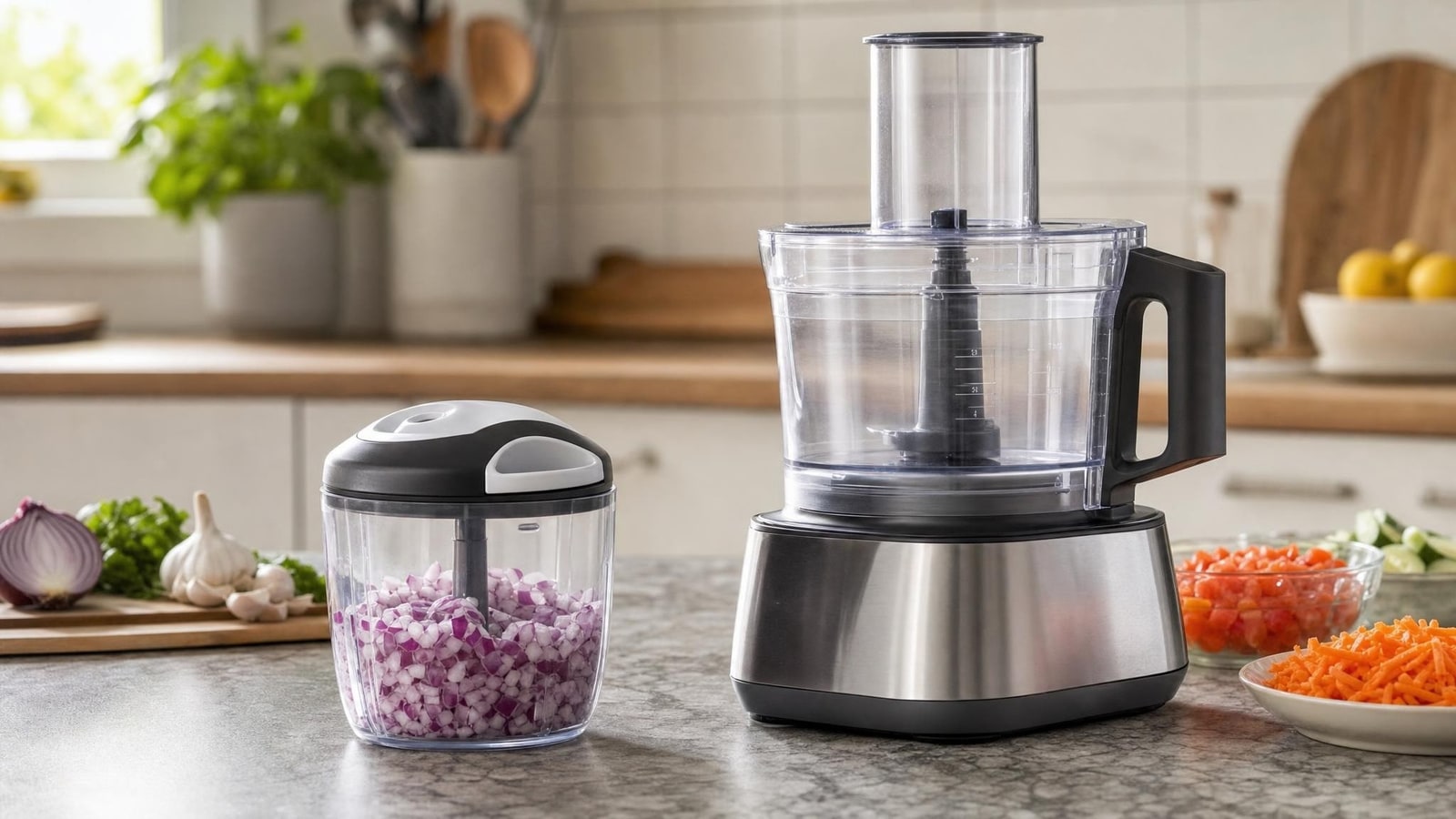
A food chopper and food processor overlap, but they are not interchangeable. Choose by batch size, desired texture, motor control, cleanup, storage, and the jobs repeated in your kitchen. One week of real prep tasks should reveal whether a compact manual chopper, powered processor, or no new appliance fits the work; neither category is universally better.
Quick product guide
Products featured in this guide
Fullstar vegetable chopper
Best for: Small to medium firm-vegetable batches where a coarse, consistent cut is the goal.
Limitation: It does not represent the slicing, shredding, mixing, or puree range of a food processor.
View on AmazonGaniza dual-bowl food processor
Best for: Cooks who need motorized chopping with separate glass and stainless-steel bowls.
Limitation: Motor base, two bowls, lids, and blade sets add storage and cleanup.
View on AmazonBonsenkitchen immersion blender with food processor
Best for: Smaller kitchens where blending and processor tasks can share one motor system.
Limitation: Attachment capacity and feed method limit batch size and do not replace a full-size slicing system.
View on AmazonCompare the fit, not a generic ranking
| Option | Best for | Strongest benefit | Main limitation |
|---|---|---|---|
| Fullstar vegetable chopper | Small to medium firm-vegetable batches where a coarse, consistent cut is the goal. | The manual format keeps a narrow chopping job compact and direct. | It does not represent the slicing, shredding, mixing, or puree range of a food processor. |
| Ganiza dual-bowl food processor | Cooks who need motorized chopping with separate glass and stainless-steel bowls. | The powered dual-bowl system represents a broader batch workflow than a manual grid chopper. | Motor base, two bowls, lids, and blade sets add storage and cleanup. |
| Bonsenkitchen immersion blender with food processor | Smaller kitchens where blending and processor tasks can share one motor system. | It represents a multi-function powered alternative without the footprint of a full-size processor. | Attachment capacity and feed method limit batch size and do not replace a full-size slicing system. |
On a narrow screen, swipe the table sideways to compare every column.
Buying criteria
Build a fit plan before opening a listing
Inventory the recurring jobs
Record ingredient, quantity, target texture, and frequency for each task. Separate chopping herbs or one onion from shredding, slicing, grating, mixing dough, pureeing, or processing a family-size batch. A category earns space only when its functions match repeated work.
Set the batch boundary
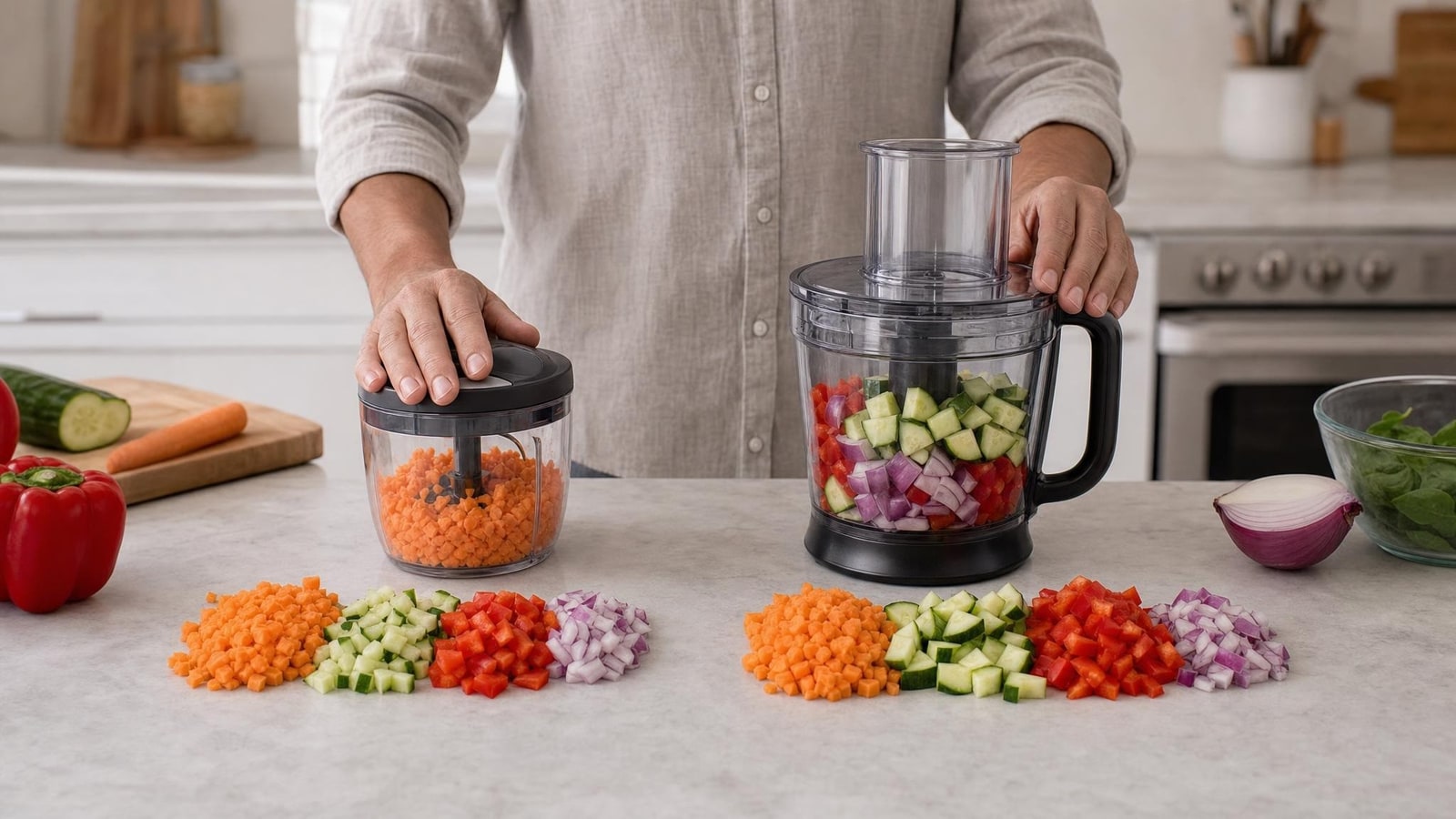
Measure the smallest and largest usual batches. A manual chopper may be quick for a modest portion but frustrating across repeated loads; a processor can be inefficient when the bowl is too large for a tiny quantity. Use usable capacity, not just headline bowl volume.
Compare control and texture
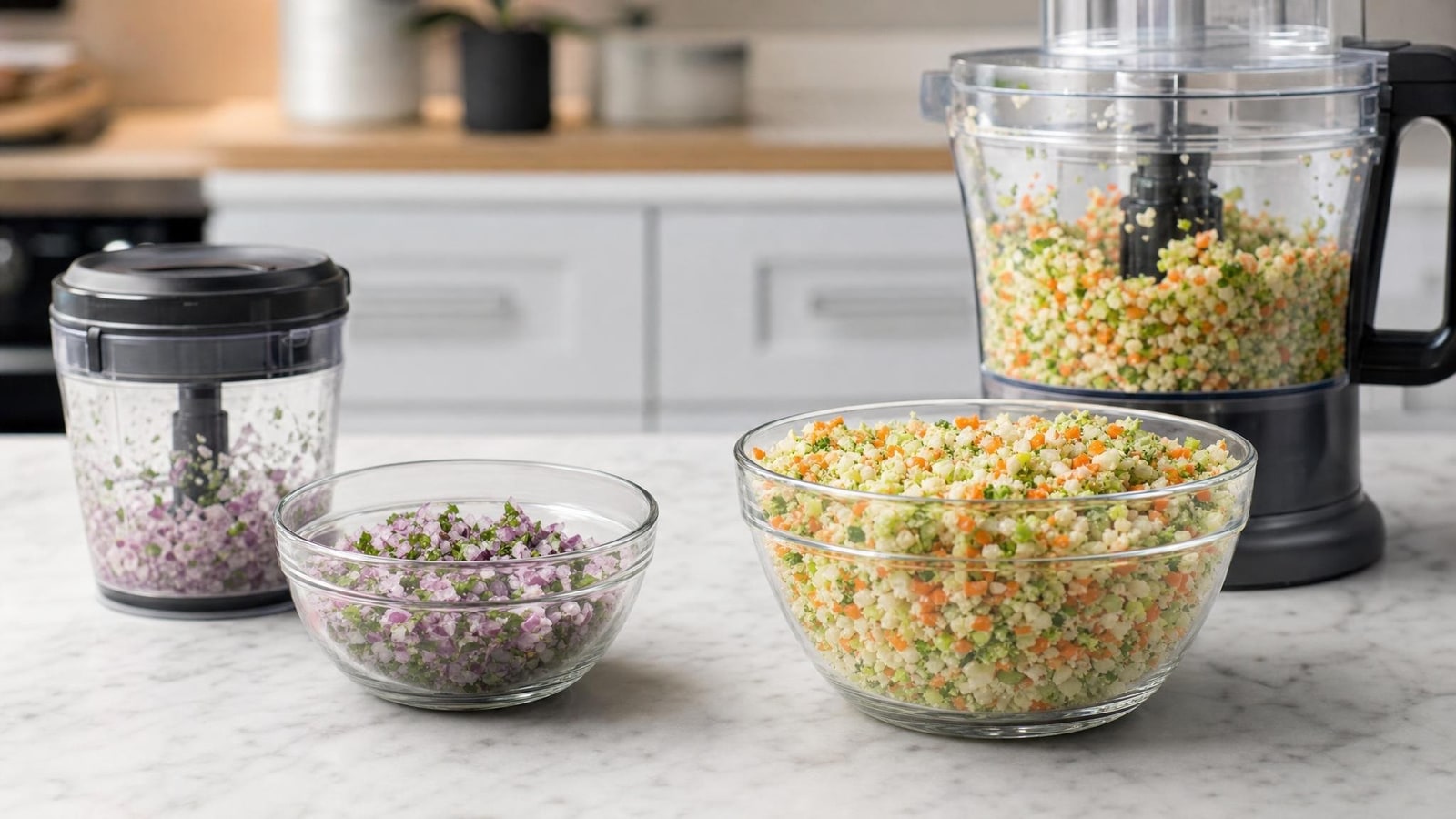
Decide whether you need distinct pieces, a coarse chop, a fine mince, a puree, or a uniform slice. Manual pulls and short pulses can offer direct feedback for coarse work. Powered processors add speed and attachments but can move from chopped to overprocessed quickly.
Run a no-buy timing test
Prepare one representative batch with existing tools and time the entire job, including collection, setup, transfer, washing, drying, and storage. Repeat only if the first attempt was atypical. The relevant comparison is total kitchen time, not seconds of blade movement.
Audit safety and handling
Check stable footing, lid interlocks, pusher use, blade removal, cord routing, and a safe place for sharp parts to dry. Do not reach into a bowl, bypass an interlock, or handle a blade while a powered unit is connected.
Score cleanup and storage
Map every washable part and where it will dry. Confirm dishwasher guidance rather than assuming it. Measure the assembled and disassembled footprint, including attachments. A tool that stays inaccessible or has nowhere to dry is unlikely to improve the routine.
Recommendations in detail
Match each option to a measured problem
Recommendation 1
Fullstar vegetable chopper
A manual grid chopper for repeat batches of firm vegetables and distinct pieces.
- Best for
- Small to medium firm-vegetable batches where a coarse, consistent cut is the goal.
- Strongest benefit
- The manual format keeps a narrow chopping job compact and direct.
- Main limitation
- It does not represent the slicing, shredding, mixing, or puree range of a food processor.
Pros, cons, evidence, and when to skip
Skip if
- Your recurring jobs are mostly sauces, dough, shredding, or thin slicing.
How we checked it
Identity, destination, and authorized product media were checked against the current controlled commerce record. See our methodology for how those checks support this recommendation. Read the editorial methodology.
Recommendation 2
Ganiza dual-bowl food processor
A powered dual-bowl processor format for repeated chopping and grinding batches.
- Best for
- Cooks who need motorized chopping with separate glass and stainless-steel bowls.
- Strongest benefit
- The powered dual-bowl system represents a broader batch workflow than a manual grid chopper.
- Main limitation
- Motor base, two bowls, lids, and blade sets add storage and cleanup.
Pros, cons, evidence, and when to skip
Skip if
- Your recurring jobs need slicing discs, dough tools, or a full-size feed tube.
How we checked it
Identity, destination, and authorized product media were checked against the current controlled commerce record. See our methodology for how those checks support this recommendation. Read the editorial methodology.
Recommendation 3
Bonsenkitchen immersion blender with food processor
A compact powered processor attachment paired with an immersion-blender system.
- Best for
- Smaller kitchens where blending and processor tasks can share one motor system.
- Strongest benefit
- It represents a multi-function powered alternative without the footprint of a full-size processor.
- Main limitation
- Attachment capacity and feed method limit batch size and do not replace a full-size slicing system.
Pros, cons, evidence, and when to skip
Skip if
- You need large batches, a wide feed tube, or dedicated processor discs.
How we checked it
Identity, destination, and authorized product media were checked against the current controlled commerce record. See our methodology for how those checks support this recommendation. Read the editorial methodology.
Alternatives and no-buy options
When none of these products is appropriate
- Use the no-purchase baseline described in this guide before adding another food chopper vs food processor product.
- Borrow or use an existing tool for one representative week and count setup, cleanup, storage, and compatibility as part of the decision.
Final recommendation
Choose the smallest system that solves the measured problem
Use the no-buy baseline first, then choose only the format whose tradeoffs fit the recurring task.
View on Amazon